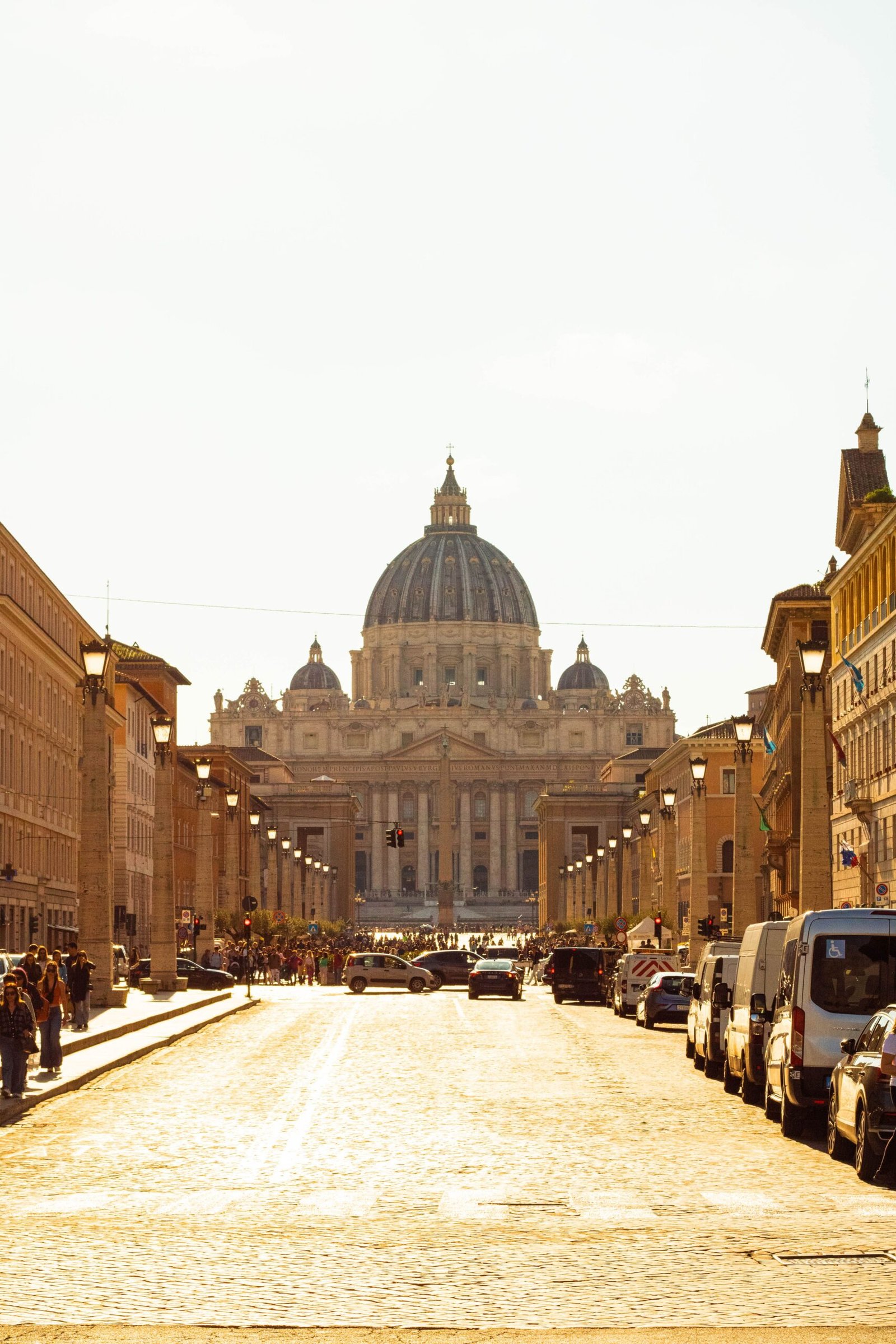
If you walk into a Catholic Mass today, you’ll hear a structure that has stayed remarkably stable for close to two thousand years: readings from Scripture, a shared creed, prayers of intercession, and a meal understood as a sacrifice. What’s easy to miss is how thoroughly Jewish the origins of this ritual are, and how much historical negotiation it took to turn a small reform movement inside Judaism into a global, Gentile-majority institution headquartered in Rome. This post traces that arc: from the first Jewish followers of Jesus, through the explosive expansion among Gentiles, to the emergence of the institutional Catholic Church and the liturgical DNA still visible in the Mass, its prayers, its creed, and its sacraments.
The First Christians Were Jews
Every single person in the founding generation of the Jesus movement was Jewish. Jesus himself was a first-century Galilean Jew who taught in synagogues, observed Passover, and never described himself as founding a new religion. His earliest followers — the twelve apostles, the women who supported his ministry, his mother Mary — were all Jews living under Roman occupation in Judea and Galilee.
After the crucifixion, the event that historians treat as the catalytic moment for the movement’s survival is the disciples’ conviction that Jesus had been raised from the dead. Whatever one makes of that claim theologically, sociologically it did something important: it kept a following together that might otherwise have dissolved, as happened with the movements around other executed would-be messiahs of the period.
The book of Acts describes what happened next as centered on Jerusalem. Fifty days after Passover, at the Jewish festival of Shavuot (Pentecost), the apostles reportedly experienced a dramatic religious event that they interpreted as the coming of the Holy Spirit, and Peter delivered a sermon that Acts credits with converting thousands. Crucially, this happened at a Jewish pilgrimage festival, in the Jerusalem Temple precincts, among Jews. The earliest community, led by Peter and later by James “the brother of the Lord,” continued to worship in the Temple, keep the Sabbath, observe dietary law, and practice circumcision. They understood themselves not as ex-Jews but as Jews who believed the long-awaited Messiah had already come. Modern scholars often call this earliest phase “the Jesus movement” precisely to signal that “Christianity” as a distinct religion did not yet exist.
This matters because it explains so much of what came later. The first Christians didn’t invent a liturgy from scratch — they inherited one. Synagogue worship already included Scripture readings, communal prayer, and psalm-singing. Jewish table blessings, particularly the ritual meals of Passover, gave the movement its most distinctive practice: the Lord’s Supper, rooted in Jesus’s final Passover meal with his disciples.
The Expansion to the Gentiles
The move from a Jewish sect to a movement dominated by Gentile (non-Jewish) converts is one of the most consequential shifts in Western religious history, and it did not happen without conflict.
Two figures drive this expansion in the New Testament narrative: Peter, who according to Acts had a vision leading him to baptize the Roman centurion Cornelius, a Gentile “God-fearer” who had not converted to Judaism; and, far more significantly, Paul of Tarsus. Paul, a Pharisaic Jew who had initially persecuted the movement, described experiencing a dramatic conversion on the road to Damascus and became the most energetic missionary to the non-Jewish world. Over roughly three decades, Paul traveled across Asia Minor, Greece, and eventually to Rome, founding communities in cities like Corinth, Philippi, Thessalonica, and Ephesus.
The central controversy this expansion produced was simple but explosive: did a Gentile convert have to become Jewish first — accepting circumcision and the full Mosaic law — before becoming a follower of Jesus? This question came to a head at what’s known as the Council of Jerusalem, described in Acts 15 and referenced in Paul’s letter to the Galatians, likely around 48–50 CE. The council, with James presiding and Peter and Paul both present, decided against requiring full observance of Jewish law for Gentile converts, asking only that they avoid certain practices (idol meat, sexual immorality, and consuming blood). This decision effectively opened the movement to the entire Greco-Roman world without the barrier of circumcision, and it is arguably the single most important administrative decision in the movement’s early history — without it, Christianity plausibly remains a small Jewish sect.
The consequences unfolded quickly. Gentile converts flooded in faster than Jewish ones. By the time the Jerusalem Temple was destroyed by Rome in 70 CE — an event that devastated the Jewish-Christian community centered there — the center of gravity in the movement had already begun shifting toward Gentile cities: Antioch (where the term “Christian” was first used, per Acts 11:26), Rome, Corinth, Alexandria, and Ephesus. By the early second century, writers like Ignatius of Antioch were already using the phrase “the catholic church” (katholikos, meaning “universal” or “according to the whole”) to describe the network of communities united in doctrine and communion with one another, distinguishing it from splinter or heretical groups.
The Beginning of the Catholic Church
“The Catholic Church” as an institution didn’t spring into existence at a single moment — it congealed gradually out of a network of local churches held together by three things: shared apostolic origin, shared doctrine, and increasingly, communion with the bishop of Rome.
In the first two centuries, local Christian communities were led by a bishop (episkopos, “overseer”), assisted by presbyters (priests) and deacons — a threefold structure that solidified by the early second century, visible clearly in the letters of Ignatius of Antioch (d. c. 110 CE). Bishops were understood to stand in a line of succession from the apostles, which gave their teaching authority. Rome held special prestige early on, both because it was the imperial capital and because it was traditionally the site of the martyrdom of both Peter and Paul. Writers like Irenaeus of Lyon (c. 180 CE) already point to the Roman church’s teaching as a benchmark for orthodoxy.
The turning point from a persecuted minority to a recognized (and eventually dominant) institution came under the Roman Emperor Constantine. The Edict of Milan in 313 CE legalized Christianity throughout the empire, ending roughly two and a half centuries of intermittent persecution. Constantine convened the Council of Nicaea in 325 CE, the first “ecumenical” (empire-wide) council, called to settle the Arian controversy over the nature of Christ’s divinity. By 380 CE, under Emperor Theodosius I, the Edict of Thessalonica made Nicene Christianity the official state religion of the Roman Empire. Over the following centuries, as the Western Roman Empire collapsed, the bishop of Rome — the Pope — increasingly became the most stable and authoritative figure in Western Christendom, a role formalized theologically over time but rooted practically in the chaos that followed Rome’s fall.
The Basis of the Mass
The Catholic Mass is, structurally, a fusion of two things: the synagogue service and the Jewish Passover meal.
The first half of the Mass — the Liturgy of the Word, with its Scripture readings, psalms, and homily — mirrors the pattern of ancient synagogue worship, where Jews gathered to read and expound the Torah and Prophets. The second half — the Liturgy of the Eucharist — reenacts the Last Supper, which the Gospels present as a Passover seder. When Jesus took bread and wine, blessed them, and said “this is my body… this is my blood,” he was performing a variation on the Jewish berakah (blessing) said over meals, particularly the Passover blessings over unleavened bread and the cup of wine.
Early Christian writers describe this liturgy taking clear shape remarkably fast. The Didache (late first century) already gives instructions for Eucharistic prayers. Justin Martyr, writing around 155 CE, describes a Sunday gathering with readings, a homily, communal prayers, and the offering of bread and wine “eucharisted” (thanks given) by the presider — a structure a modern Catholic would recognize immediately. The word “Mass” itself comes from the Latin dismissal, Ite, missa est (“Go, it is sent” / “the dismissal”), used to close the liturgy.
Prayers and the Creed
Many of the Mass’s prayers have equally deep roots. The Sanctus (“Holy, Holy, Holy”) draws directly from the Jewish prophet Isaiah’s vision of angels around God’s throne (Isaiah 6:3), a text also used in Jewish synagogue liturgy. The Our Father, the prayer at the heart of the Mass, is presented in the Gospels as Jesus’s own teaching to his disciples, itself patterned on Jewish prayer forms of the era. The Kyrie eleison (“Lord, have mercy”) reflects a persistent Old Testament refrain of appeal to God’s mercy.
The Creed recited at Mass — usually the Nicene Creed — has a very specific and traceable origin. It was drafted at the Council of Nicaea in 325 CE, primarily to refute Arianism (the view that Christ was a created being, not co-eternal with God the Father), and expanded at the Council of Constantinople in 381 CE, which is why it’s technically called the Niceno-Constantinopolitan Creed. It was inserted into the Mass itself somewhat later — the practice spread from the Eastern Church and Spain in the sixth century and reached Rome around 1014 CE. So while the content of the creed reflects fourth-century doctrinal battles, its role as a recited part of the Mass is a later development still.
The Sacraments
Catholic theology recognizes seven sacraments — Baptism, Confirmation, Eucharist, Reconciliation (Confession), Anointing of the Sick, Holy Orders, and Matrimony — but this specific number wasn’t formally fixed until the medieval period, notably articulated by theologians like Peter Lombard in the twelfth century and dogmatically defined at the Council of Trent (1545–1563) in response to the Protestant Reformation. That said, the practices themselves are ancient. Baptism appears from the movement’s earliest days, rooted in Jewish ritual immersion (mikveh) and John the Baptist’s practice in the Jordan. The Eucharist, as discussed, traces to the Last Supper. Ordination through the laying on of hands appears in Acts and Paul’s letters. Confession of sins and reconciliation with the community are attested in the Didache and early penitential practices. What changed over time wasn’t the existence of these rites but their systematic organization into a fixed theological category — a good example of how doctrine often formalizes longstanding practice rather than inventing it wholesale.
The Throughline
What’s striking, when you trace this whole arc, is the continuity underneath the transformation. A reform movement among first-century Jews in Roman Judea became, over four centuries, the official religion of the Roman Empire and the institutional ancestor of the Catholic Church — yet its central act of worship still carries the fingerprints of a Passover meal and a synagogue service two thousand years later. The theology developed, the institutional structures hardened, and the demographic center moved from Jerusalem to Rome, but the liturgical bones stayed remarkably intact. Understanding that inheritance doesn’t just illuminate church history — it’s a genuinely useful case study in how religious traditions evolve: not by clean breaks, but by carrying forward the practices of what came before, even as they redefine who belongs and what those practices mean.
No responses yet