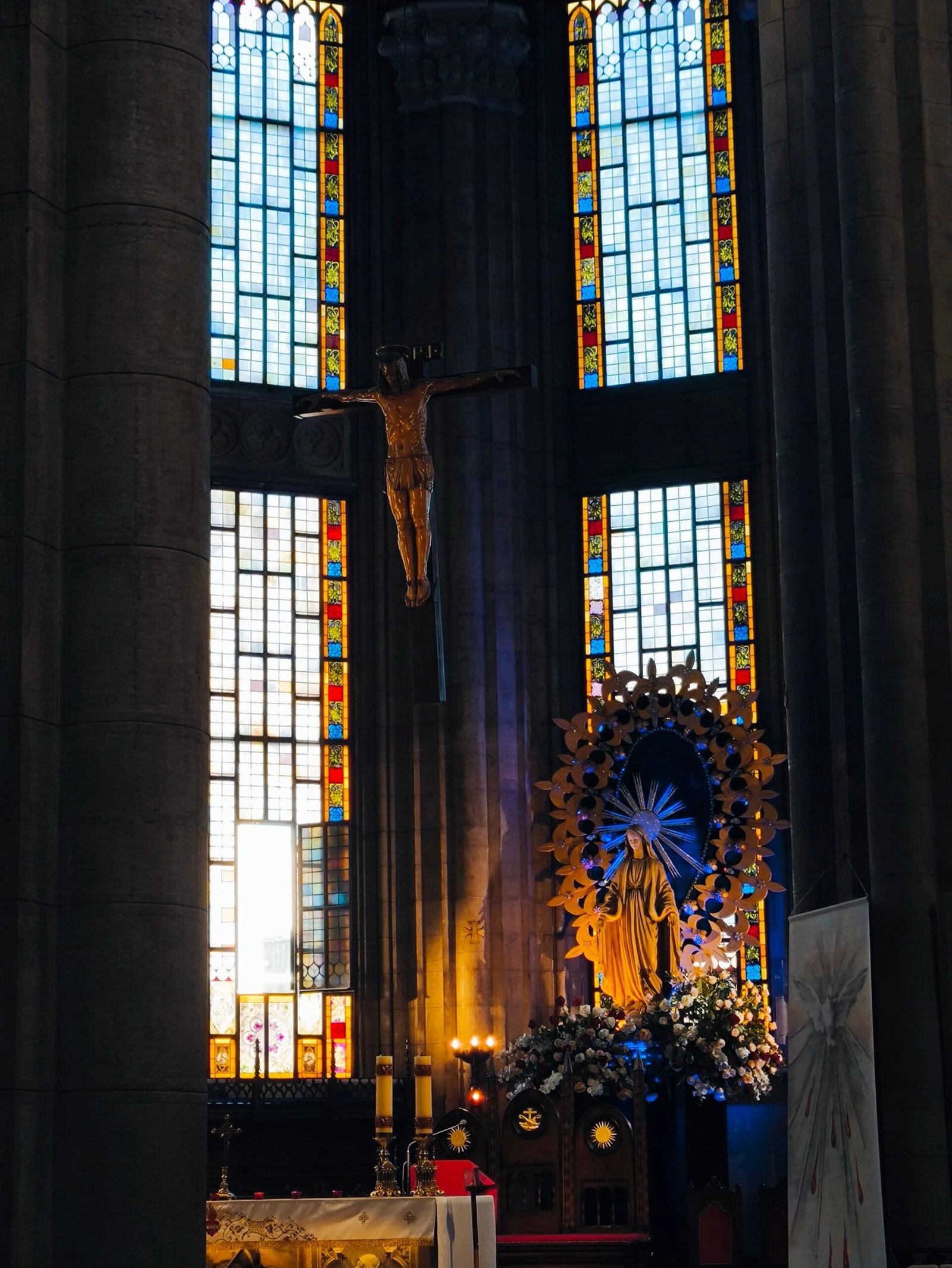
An honest look at Catholicism’s impact on individuals, communities, and nations—its charity, structure, and moral vision, alongside the guilt, shame, and poverty theology that can hold believers back.
The Largest Spiritual Institution on Earth
No single religious body has shaped more hospitals, schools, orphanages, and moral vocabulary than the Catholic Church. With well over a billion adherents, its influence runs through law, art, education, and the inner emotional life of people who have never set foot in a pew. That scale means Catholicism’s effects are neither uniformly good nor uniformly harmful—they are large enough to contain both. This piece holds that tension deliberately. It is not an argument for or against the Church; it’s an honest accounting of what the tradition builds, what it sometimes breaks, and how people raised inside its framework can work through the parts that keep them small.
The Positive Legacy: Building People, Communities, and Nations
Institutional care at scale. Catholic religious orders founded some of the world’s oldest continuously operating hospitals and universities. Wherever the Church has had a sustained presence, it has tended to leave behind infrastructure—schools, clinics, relief networks—that outlasts any single pope or bishop. In the developing world today, Catholic charities remain among the largest non-governmental providers of health care and education, often reaching communities that neither markets nor governments have prioritized.
A coherent moral vocabulary. Catholic social teaching gives people a shared language for human dignity, subsidiarity, and the common good. Concepts like the “preferential option for the poor,” developed within twentieth-century Latin American liberation theology, pushed the Church toward direct advocacy for the economically marginalized rather than abstract charity alone. Whatever one thinks of the theology behind it, it gave millions of poor communities an institutional ally with real political and financial weight.
Ritual and belonging. The sacramental structure—baptism, confession, the Eucharist, marriage rites, last rites—marks every major life transition with communal meaning. Sociological research on religious participation consistently associates regular communal worship with lower rates of loneliness and higher rates of volunteering, regardless of the specific tradition. For many Catholics, the parish functions as a durable social safety net that predates and often outperforms secular civic institutions in the same neighborhood.
Intellectual and artistic inheritance. From Aquinas’s synthesis of faith and reason to the Sistine Chapel, Catholic patronage produced an enormous share of Western art, architecture, and philosophy. The Church’s historical insistence that faith and reason are not enemies gave rise to the university system itself.
Where the Teaching Can Become a Limiting Belief
Original sin and the worthiness problem. Catholic doctrine holds that humanity inherits a fallen nature from Adam, requiring baptism and grace to be restored to right relationship with God. Theologically, this is meant to explain human moral struggle and to make grace meaningful—you need rescuing because you’re actually in trouble. Psychologically, though, when this doctrine is taught poorly or absorbed young, it can calcify into a felt sense of being fundamentally defective rather than fundamentally loved. The difference between “I did something wrong” and “I am something wrong” is enormous, and a lot of Catholic guilt confusion lives exactly in that gap.
The confession-shame loop. The sacrament of reconciliation is designed as a release valve—confess, receive absolution, move forward clean. Done well, it works exactly that way. But in practice, many Catholics describe a cycle where confession relieves guilt only until the next transgression, without ever addressing the underlying shame narrative driving the behavior. Grace becomes something you have to keep re-earning through the ritual rather than something you simply stand in.
Institutional failure and trust. The clergy sexual abuse crisis, documented extensively across multiple countries over the past several decades, represents a real and devastating failure of institutional accountability, not a peripheral footnote. Any honest treatment of Catholicism’s legacy has to hold this alongside its charitable record. The two facts—the hospitals and the cover-ups—are both true of the same institution, and neither cancels the other out.
The wealth paradox. The Church teaches detachment from material wealth and the special dignity of the poor, while the Vatican itself holds an enormous portfolio of art, real estate, and financial assets. This isn’t necessarily hypocrisy—institutions and individuals can hold different relationships to wealth—but it creates a genuine tension that believers raised on both “blessed are the poor” and visible institutional opulence have to work through for themselves. It also echoes a pattern worth naming honestly: aspirational teaching about poverty and detachment doesn’t always match lived institutional practice, a gap that shows up across traditions, not just this one.
Poverty theology as resignation. Some strands of popular (not official) Catholic piety have historically framed poverty as spiritually purifying almost in itself, which can slide into a passive theology that discourages economic ambition or treats financial struggle as something to be spiritually endured rather than addressed. This is distinct from the Church’s actual social teaching, which calls for structural change on behalf of the poor—but the folk version often wins in practice.
Moving From Guilt to Grace: A Practical Path
For people who grew up inside this framework and want to keep what’s good while releasing what isn’t, a few reframes tend to help:
Separate the doctrine from the delivery. Official Catholic teaching on grace (per the Catechism) emphasizes that grace is freely given, not earned through performance. If what a person internalized feels more like a debt they can never fully repay, that’s likely a distortion picked up from a particular parish, family, or teacher—not the core doctrine itself.
Treat confession as a tool, not a treadmill. The sacrament works best as a structured practice for honest self-examination and course correction, not as the sole mechanism for feeling acceptable. Pairing it with ongoing self-reflection—journaling, spiritual direction, or therapy—tends to break the guilt-relief-guilt cycle more effectively than the ritual alone.
Hold institutional failure and personal faith as separable. It’s possible to take the abuse crisis seriously, demand accountability, and still find personal meaning in sacramental life or Catholic moral teaching. Conflating “the institution failed people” with “the theology is worthless” forecloses a conversation many thoughtful Catholics are actively having.
Distinguish aspiration from poverty as identity. The call to detachment from wealth is about ordering priorities, not about believing you’re less worthy for having resources or more virtuous for lacking them. Financial stability and generosity aren’t in tension with Catholic teaching properly understood—the Church has always run on both.
Self-Critique: Where This Piece Could Be Challenged
A devout Catholic reader might reasonably object that this piece leans too heavily on folk piety and popular distortion rather than the Church’s actual magisterial teaching, which explicitly rejects the idea that poverty is intrinsically virtuous or that grace must be re-earned. That’s a fair critique—official doctrine and lived practice diverge here, and this piece has tried to name that gap rather than collapse the two, but a Catholic theologian would likely want more space given to the Catechism’s actual language on grace. Conversely, a critic of institutional religion might feel this piece is too generous toward an institution with a documented abuse crisis, treating it as one data point among several rather than a disqualifying one. Both readings are available in the tension held here, and neither is resolved—by design.
References
- Catechism of the Catholic Church (1992), sections on grace and justification
- Gustavo Gutiérrez, A Theology of Liberation (1971)
- Pew Research Center, studies on religious participation and civic engagement
- John T. McGreevy, Catholicism and American Freedom: A History (2003)
- Reports of national and Vatican-commissioned inquiries into clergy sexual abuse (multiple countries, 2000s–2020s)
- Second Vatican Council documents, particularly Gaudium et Spes on the Church and the modern world
No responses yet